Our Open Days on 4th and 5th September welcomed around 60 guests to Henfaes, over two days of perfect summer weather. 

James outlines his PhD research
Our tomato experts were there in force on the first day. Simon Crawford of Burpee Europe introduced our collaborative  project on breeding tomato varieties with better resistance to late blight. John Burrows and Barry Smith from ProVeg  provided tomato samples for guests to taste and score. James Stroud (PhD - KESS student with SRT and Bangor University) told us about his latest results on breeding with resistance genes and on a comparison of populations of Phytophthora infestans taken from tomato with that from potato in UK. James is making good progress identifying resistance genes using molecular probes and combining these in progeny that have desirable traits for the amateur and professional grower.

Simon Crawford, James and Katherine
discuss the trial with Medwyn Williams
Katherine explains the tunnel trial
After the talks, Simon, John, Barry and Katherine Steele (KESS supervisor, Bangor University) showed guests around the field and  poly tunnels  Here, selected genotypes and cultivars are on trial for their blight resistance, taste and use in the UK outdoor climate. 
 David Shaw introduced and updated our work on the Sarpo range of blight resistant potatoes.  A current research strand involves treating blight-susceptible varieties of potato with dilute sea water. Results show this can suppress tuber blight and increase crop yield. A trial  with a foliar feed containing phosphite (Phi-Diamond) showed suppression of foliage blight and also increased yield of tubers of blight susceptible cultivars.
Simon White explains the replicated potato trial

Simon White told guests about the production of Sarpo seed potato crops in North Wales and elsewhere and his ongoing project selecting new Sarpo varieties. We were pleased to introduce David Gale who is now managing sales of Sarpo seed for our new company, Sarpo Potatoes Ltd, which is owned by the Trust.

When we visited the field trial of potatoes, guests saw Sarpo blight resistance in action. Replicate plots of selected cultivars and potential cultivars were showing little or no foliage blight They  stood out from plots of susceptible cultivars (dead) and of controls with only moderate resistance.

David Shaw and Simon in the potato trial
We were pleased to welcome some of our team of Buzzbnk Crowdfunders on the Friday. A few of these are having fun doing their own crosses and selecting for traits that interest them.  This activity was common among amateur growers in the 19th century and should be pursued more often today.  You never know, you might find a winner.

We were pleased to welcome our own Potato Guru from Fyfe, Alan Romans.  Alan told us what the Sarpo potatoes mean to him and their greater importance in the world of potatoes. He emphasised that they are a different breed of potato from those most often grown.  To be grown well they need to be understood and treated differently e.g. their ability to be used early, mid-season and late and the dangers of letting them grow on too long in the autumn. Experiment!

On both days, our visitors enjoyed  a potato-themed lunch made with Sarpo varieties and cooked by CafĂ©-Deli 1815. Chips made from new-season’s Blue Danube went down well, and so did the  local Jones o Gymru crisps.

Sarvari Research Trust is part supported by the Supply Chain Efficiencies scheme of the Welsh Government under the European Agricultural Fund for Rural Development.


THE BLIGHT BITES

As always, the blight season in 2014 has been different from all others.  Some sites had severe infections in June and others, not more than a mile away, did not suffer infection for another month.  Differences are partly due to microclimate but more likely this year is presence or absence of an active source of infection ie spores being produced from a sprouted and infected tuber that was bought in as seed or was dumped or unharvested from a last year's crop.
Our trial at Henfaes now has dead plots of susceptible varieties (like King Edward and Maris Piper) and growing plots with little or no blight indicating a genotype with substantial resistance.  Simon is scoring the percentage of foliage infected within each plot at regular intervals.  The trial should be demonstrating differences of resistance/susceptibility for all genotypes in time for our Open Days on 4 and 5 September.
Plant pathologist, George Little, from Northern Ireland (Bangor) discussing resistance of clones with Simon in trial at Henfaes.  The King Edward plot has dead foliage
s

Blight is off to an early start.

Every year the disease we call Late Blight is around and waiting to destroy our crops of potato and tomato.  And every year, the arrival and reproduction of the pathogen, Phytophthora infestans, is different.  Last year we didn't see much disease until very late in the season but we had a very mild winter.  This means that unharvested tubers lying on or just under the soil surface were not frosted and some of these must have carried a latent infection of blight. Some of these infected tubers will grow on as volunteers in the next crop or in a ditch or discard pile and in a small percentage of these the blight will grow into the sprout and produce spores on the leaves and stems. Similarly, latent infection on seed tubers can give rise to an outbreak of the disease.

That's how blight gets started each year. The first sample, from a dump, was noted on 9th May.  This is quite a bit earlier than usual.  The weather in May and in early June favoured blight reproduction and spread - that is, minimum temperatures above 10C and high humidity or rainfall. As a service to potato growers, the Potato Council Ltd has a web site that records when blight has been detected in postcode areas throughout GB.  This depends on potato professionals (Blight Scouts) sending leaves or stems from suspected outbreaks to FERA for confirmation. Amateurs (Monitors) are also encouraged to  register and receive prepaid mailing envelops and instructions. Dots are placed on the map so that the risk of blight arriving on healthy crops can be assessed.  Conducive weather (Smith periods) AND a confirmed outbreak in your area means that you  must watch your crop carefully for the first signs of the tale-tale brown/black spots on leaves and stems that indicate blight. That is when the commercial grower will protect his crop with fungicide and apply it at weekly intervals to prevent any infection. In dry conditions, the weekly applications are usually discontinued or extended.

Of course growers of our Sarpo varieties do not need to use fungicide.  But if you are growing a Sarpo cultivar with moderate resistance on a large scale you might consider less frequent application of preventive fungicide particularly in a wet season.

A measure of the earliness of blight this year is that 88 samples of blighted foliage were sent in by the end of June whereas you need to go back to 2006 or 2007 to find anything approaching this number.  In 2006, 60 blight outbreaks were detected and 56 in 2007 (which later became a blight meltdown year).
Our trials at Henfaes have remained healthy so far in spite of severe blight outbreaks on the allotments at Llanfairfechan a few miles to the east. Early attacks are devastating as the whole plant may lose all foliage before any tubers have formed = CROP FAILURE.

Allotment gardens are often places where blight develops.This is because lots of susceptible varieties are grown, few if any are sprayed against blight and hygiene in not always up to scratch e.g. dumps of old tubers and volunteers on neglected plots. So 2014 has the makings of a meltdown year again but it all depends on the weather during July and August.  We just might escape.
Open Day at Henfaes in Mid June - no blight in sight - yet.
This plant was infected soon after emergence. Latent infection of the seed tuber is a strong possibility here.

New Scientist letter on blighted Sarpos - but was it late blight?

Today's New Scientist has a letter from Andrew Sanderson, Co Durham who grew Sarpo Una and Sarpo Mira. He says that the Sarpo varieties suffered from blight whereas the variety Kestrel was unaffected.  He makes no mention of the crop of tubers he harvested from each variety.

The blight scores recorded in the 'official' database for Kestrel is 5 for foliage blight and 3 for tuber blight (scale 1-9 where 1 is susceptible and 9 is highest resistance). On the same scale, Sarpo Mira scores 7 (foliage) and 9 (tubers); Sarpo Una foliage is 6 and tubers 5.  In our own trials we find similar results except that Sarpo Mira usually scores 8 on foliage.

 Now, what could be going on here?  Have the Sarpo varieties changed in their resistance due to evolution of the blight pathogen? Before we jump to that conclusion there are other possible explanations. The short note does not say if plants were all grown close together in a garden plot or separated spatially. Microclimate varies across even a small plot so that after rain, foliage may dry more  quickly in one microsite and slower in another. This would affect the severity of blight infection.

It is assumed that the blight was the late-blight disease caused by Phytophthora infestans. But dark spots on the leaves can be due to other diseases and pests or even to nutrient deficiency in the soil.  Sarpo Mira often shows deficiency symptoms on lower leaves that are not disease related and do not seem to affect yield.

If Andrew has an experimental bent, he could try growing the same varieties from fresh certified seed and if similar results are obtained, samples could be sent to SRT for positive identification. Even better, he could give half the seed of each variety to a friend and have them grown on a different site and compare results.


Dublin on St Pat's weekend, Potato Day in Leitrim and 6nations win

The invitation to be key speaker at The Organic Centre's Potato Day in Leitrim was the excuse I needed to cross the small pond, renew old potato friendships and develop new. It was good to eat again at Mulligan's in the Stoneybatter.  They supply an amazing range of Irish and foreign ales. Friday was a fine day and ideal for a quick survey of seed potato outlets in Co. Wicklow with Colm.  Had a quick look at Mount Usher Garden and vowed to return at leisure; not a potato in sight.
Copper spray on sale with seed potatoes - gardeners do not know how lethal this stuff is!

Dinner at Podraig Galligher's The Boxty House in Temple Bar. As you would expect, he uses substantial quantities of ware spuds and is keen to put Sarpos on the menu and grow some Sarpos as decoration for outside the restaurant.


Podraig's Potato Scratchings are made from thin slices of Boxty - scrummy.
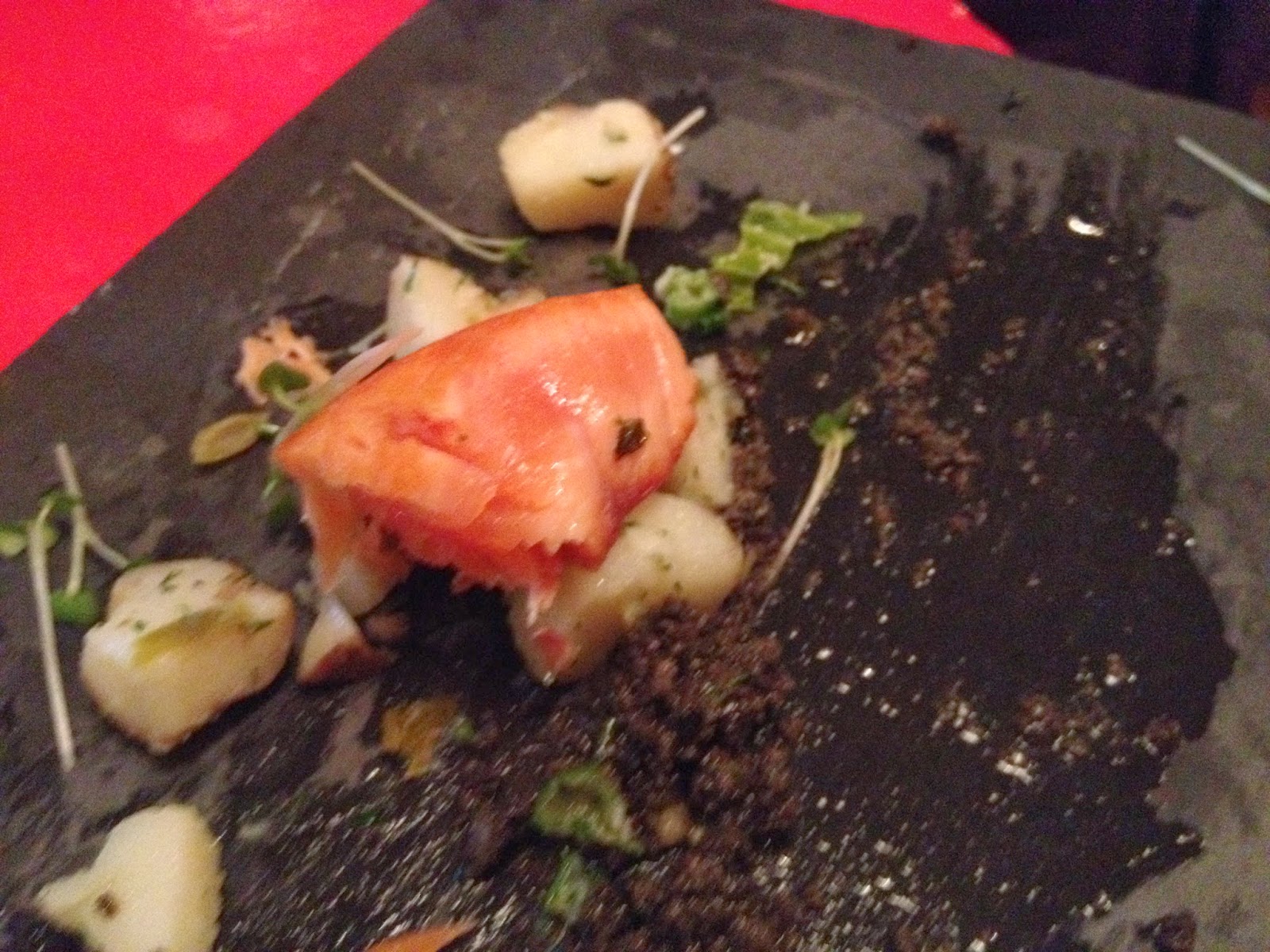
Turf-smoked salmon with Lumper potatoes

Colm O’Callaghan drove us to Leitrim on Saturday in time for a great potato lunch.  We had a sharp audience for the Sarpo talk although I hear 6-nations game kept some at home. After much potato crack, Colm drove us back via the stunning scenery of Kinlough and Enniskillin, diving in and out of NI Co. Fermanagh – real blight (and famine) country.


Sunday was a grand day. We met farmer John Swabby-Miller at Red Cross, Co. Wicklow to see his part-harvested crop of Axona.  Although planted late, the crop grew away fast and smothered a huge weed population including thistles. The field where the Axonas were still to harvest was totally free of weeds and the test digs yielded excellent samples that Kaethe will offer to the great and the good of the Dublin food scene.  John grows a range of veg for his farmers’ market at Red Cross.  He is offering to grow plots of all the Sarpos for demonstration in the summer.

Axona samples look in excellent condition

CROWDFUND POTATOES ARE ON THEIR WAY

Our lenders are due Sarpo Seed Potatoes as part of the interest we pay on the loan.  We are trying very hard to send these out this week and next so that you can get them planted as soon as possible. 

We would appreciate if growers could pay for post and package; we will let you know by e-mail how much that will be.

Crowdfunding Success to Revolutionise Potato Growing

We are delighted to announce that we have completed our Crowdfund on BUZZBNK and managed to raise £42,445.00. 

During the 90-day appeal, we rapidly achieved our first milestone of £20,000 and motored on to get fairly close to our second milestone of £50,000.  This could not have been done without all our supporters who recommended our cause to so many friends and contacts. The Buzz on twitter and Facebook was amazing.  

So, many thanks to all who supported us and especially to those contributing donations and loans. We would also like to thank the team at Buzzbnk for helping acheive our aims and to the A-Team Challenge that match-funded us to the tune of £10,000. We are working hard now to pay Sarpo-seed interest to our lenders so that they can plant the seed as the soil warms up. We wish all our growers good luck with their crops. We would be delighted to hear about your experiences with Sarpo in the field or garden and also in the kitchen.  

The production and sales team are now able to make ready for a new launch of our Sarpo varieties and for sales next winter, in as many outlets as possible.

Apologies for this blog being late.  I was in Dublin and Leitrim attending Potato Events in the run-up to St Patrick's Day.  Of this, more later.